


Company
03 November 2026
 14:07
Allen Wang | CEO and Founder, HIPAD
Updated: October 29, 2026
A floor spring for glass door projects must be selected against the complete entrance, not a catalog headline. HIPAD’s supplied Door Controls reference lists floor springs for glass and entrance doors up to 150 kg with a 180-degree opening reference. Before approval, confirm the quoted model, door geometry, floor construction and glass fitting interface through drawings and a representative sample.

The HIPAD source library provides family-level values, not a universal rating for every configuration. Use the comparison below to frame a supplier inquiry.
| Family | Published door-weight reference | Published opening reference | Approval question |
|---|---|---|---|
| Floor spring | Up to 150 kg | 180 degrees | Does the exact model suit this leaf, installation and closing requirement? |
| Pivot system | Up to 200 kg | 180 degrees | How are the door and its supporting structure connected? |
| Door closer | 60-120 kg | 120-180 degrees | Is a surface or other closer arrangement appropriate? |
| Stainless-steel patch fitting | Not stated | Not stated | Does the specified fitting match the glass preparation? |
A floor spring, pivot and closer do not become interchangeable because their opening references overlap. Compare function and installation in the HIPAD Door Controls range. The product reference does not disclose a certificate number, model-level load table or a single fitting geometry for all floor springs.
Send the supplier the leaf height, width, thickness, glazing build-up, measured mass and intended pivot position. A wide leaf can change forces on the controls even if its mass falls below the family maximum. Request the quoted floor spring’s application range, fixing layout and complete matching hardware schedule. Do not convert “up to 150 kg” into a guarantee for an unspecified door.
For a replacement installation, measure the existing recess, spindle position, floor finish height and upper support alignment. A replacement with a similar headline capacity may still place the glass in the wrong closed position. If the layout is a pivot entrance instead, the pivot door system guide sets out the distinct structural checks.
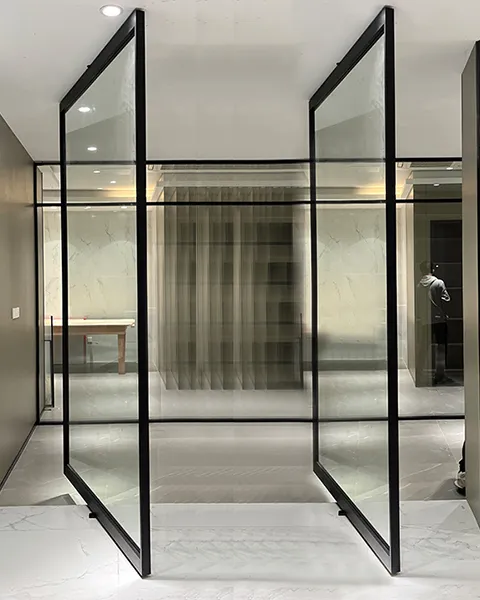
Ask the project engineer to identify the structural substrate, recess depth, finished floor build-up, waterproofing and permissible fixing zones. The supplier’s installation drawing must match those conditions. A shallow floor or concealed service route can rule out an otherwise suitable-looking unit. The supplied reference does not provide a universal anchor schedule, so do not improvise one from a product photograph.
Coordinate floor and head support axes in the same drawing set. Check access for adjustment and future service without assuming every model has the same adjustment features. Record any project-specific fire, accessibility or safety requirement and obtain evidence for the exact offered assembly.
A published 180-degree opening reference is not a promise that an installed glass leaf can reach that angle. Adjacent walls, handles, stops, seals and pivot offset may limit travel. Build a production-intent sample, measure the usable angle and verify that the glass does not contact nearby construction through its swing.
HIPAD lists stainless-steel patch fittings, but the supplied reference gives no universal glass-thickness or numerical load rating for that family. Request the fitting drawing and glass preparation requirements. Check the patch fitting, floor spring and upper support as a coordinated set. The door-closer guide explains why weight and opening ranges alone cannot settle an assembly decision.

EN 1154 addresses controlled door closing devices and is useful terminology when discussing evidence. It is not proof that a particular HIPAD floor spring is certified. Ask for model-specific reports if the project requires conformity. Prices and product-level certificate numbers are not disclosed in the supplied material; request a quote for the specified model and quantity.
No. The published value is a family reference. Door geometry, model conditions, floor support and matching fittings still need approval.
No. The available angle depends on pivot position and surrounding construction. Measure it on the representative entrance.
That is risky. Obtain the exact fitting drawing and glass preparation before fabrication, then check its compatibility with the chosen control.
Raise the constraint before selecting the model. The supplier and project engineer must verify a compatible installation; do not alter structural details from a generic diagram.
For an OEM sample or model-specific quotation, send HIPAD the door schedule, floor/head details and glass preparation requirements. The next approval point is the complete assembled entrance, not the family headline rating. The supplier checklist can help document drawing and inspection control.
About the author: Allen Wang is CEO and Founder of HIPAD. His supplied background describes manufacturing experience beginning in Qingdao bearing production in 1998 and work with international architectural-hardware buyers. This article uses HIPAD’s Door Controls family reference; a project still needs model-specific documents and installation review.
We will reply within 24 hours. For urgent requests, contact us on WhatsApp/WeChat at +86 137 9191 8989 or call the same number directly.
*We respect your confidentiality, and all information is protected.
We will only use your information to respond to your inquiry and will never send unsolicited emails or promotional messages.
