













Company
16 October 2026
 11:17
11:17 Allen Wang | CEO and Founder, HIPAD
Updated: August 11, 2026
Custom door hardware is produced against a buyer’s application, dimensions, material, finish, interface, branding, and packaging requirements. A workable OEM project starts with the door system and installation constraints, then moves through drawings, samples, approval, batch controls, and repeat-order documentation. The product image should come after the specification.
Custom door hardware is any handle, lock-related component, hinge, roller, bolt, closer accessory, or fitting changed or developed for a defined door system or commercial program. The change may be simple, such as a finish, logo, or carton label. It may also require a different hole pattern, spindle interface, base geometry, length, material, private mold, or complete assembly.
For a B2B buyer, “custom” should describe controlled variables rather than a visual preference. The same handle shape can fail if its fixing centers do not match the profile, its base interferes with the frame, or its spindle does not engage the lock body correctly.
Compared with retail custom-hardware collections, an OEM program must answer three additional questions:
HIPAD supports drawing-based OEM/ODM development, material and finish selection, structural adjustments, logo application, private molds, and customized packaging for door and window manufacturers, distributors, and project buyers.
Before asking a factory to quote custom door hardware, define where the hardware will operate. A useful request identifies the door type, profile or panel material, door thickness, handing, mounting space, mating components, expected environment, and installation method.
Use this specification framework for the first technical review:
| Specification item | Information to provide | Why it matters |
|---|---|---|
| Application | Entrance, interior, sliding, bathroom, glass, aluminum, UPVC, or another system | Narrows the suitable hardware family and installation method |
| Door or profile | Section drawing, profile sample, glass thickness, or panel construction | Reveals interference, fixing depth, and edge-clearance risks |
| Interface dimensions | Hole centers, backset, spindle size, base footprint, fixing thread, and projection | Determines whether the hardware mates with the door and lock system |
| Material requirement | Required base material or the performance condition it must satisfy | Affects corrosion behavior, weight, machining, finish, and cost |
| Finish reference | Physical sample, approved color standard, gloss level, and texture | Reduces color and surface-appearance disputes |
| Operating requirement | Cycle target, load condition, locking function, or project test requirement | Connects the design to a measurable acceptance method |
| Branding | Logo artwork, process, location, size, and orientation | Prevents inconsistent marks or marks hidden after installation |
| Packaging | Unit protection, label data, barcode, carton quantity, and pallet rules | Protects the finish and supports warehouse identification |
If a buyer has only a physical sample, custom door hardware measurements still need to be converted into an approved drawing. A sample is useful evidence, but it is not a complete production specification by itself.
HIPAD’s published custom door hardware handle families cover window handles, sliding-window flush handles, interior lever handles, aluminum door handles with locks, and entry-door mortise handle sets. The referenced door or window thickness range is approximately 30-80 mm depending on the configuration.
The broader published family references provide a more useful starting point:
| Handle family | Published application reference | Thickness reference |
|---|---|---|
| Aluminum or zinc window handles | Window-frame applications | 40-70 mm frames |
| Sliding-window flush handles | Sliding-window profiles | 30-60 mm frames |
| Zinc alloy or aluminum lever handles | Interior door applications | 30-50 mm doors |
| Aluminum door handles with locks | Door and lock combinations | 35-60 mm doors |
| Mortise handle sets | Entry and mortise-lock applications | 40-80 mm doors |
These ranges are family-level references, not a promise that one model fits every thickness. The lock case, spindle length, fixing screws, escutcheon or base, door profile, and required clearances must be checked together. Buyers should request a configuration-specific drawing before approving a sample.
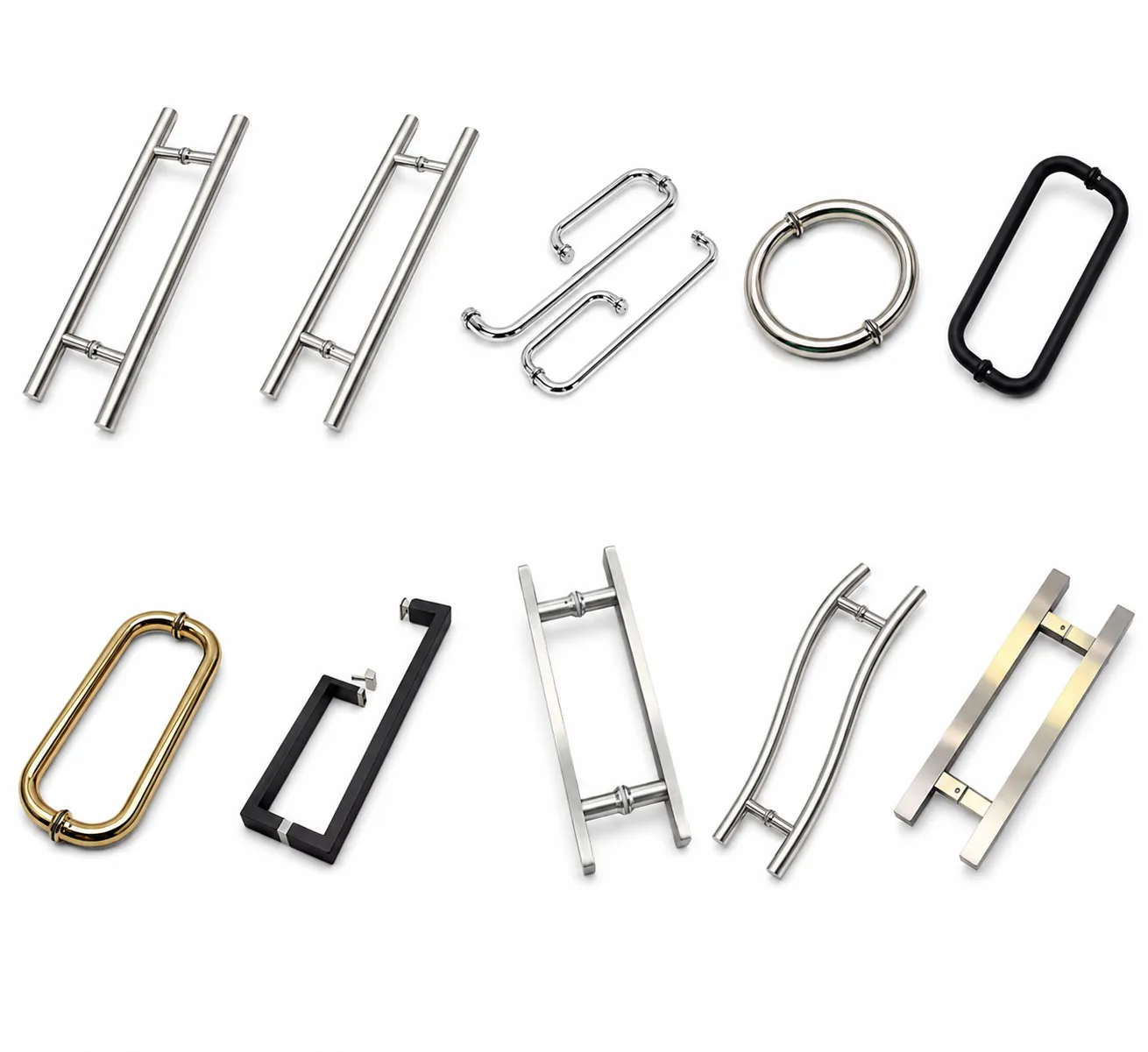
For examples of pull-handle forms used in glass-door applications, see HIPAD’s bathroom glass door handles range.
For custom door hardware, select material against the operating environment and mating parts. Aluminum suits many profiles, zinc alloy supports detailed handle geometry, and stainless steel is commonly considered for pull handles and wet areas. Alloy or grade, section thickness, fixings, finish, and contact between the body, spindle, fasteners, lock interface, and door profile still require review.
HIPAD’s guide to door hardware finish selection explains how finish decisions affect appearance and application. An approved finish sample should still control the OEM order.
A custom door hardware production drawing should make acceptance measurable. Define overall dimensions, projection, base size, mounting centers, thickness range, spindle engagement, fasteners, lock interface, datums, tolerances, material, finish, logo, handing, assembly, and packaging. Mark critical-to-fit dimensions separately because they can stop installation even when the product looks correct. For replacement programs, compare the drawing with the installed base and retain the approved revision.
Use a written change-control rule after sample approval. A material substitution, revised screw, different spring, altered finish process, or packaging change may affect fit, function, appearance, or transit protection. The supplier should identify the proposed change, explain its effect, and obtain approval before production. The buyer should also route its own profile, lock, or installation changes through the same review instead of assuming the approved hardware will remain compatible.
For custom door hardware, this record also protects repeat orders from unapproved substitutions.
Tie custom door hardware inspection to failure modes. For a handle set, check mounting centers, base dimensions, spindle interface, screw engagement, function, finish, logo position, and packaging protection. HIPAD states that internal QC checks are used through production and that third-party providers such as SGS and Bureau Veritas can be involved when required. This does not mean every product carries an SGS, BV, or ISO product certificate. ISO 9001:2015 describes quality-management systems; it is not a substitute for product-specific testing.
HIPAD supports dimensional and structural adjustments, finish selection, logos, packaging, drawing-based development, and private molds. Custom door hardware feasibility depends on the design, tooling, materials, interfaces, quantity, and intellectual-property restrictions.
Provide the sample or drawing, mounting centers, base footprint, spindle or lock interface, door thickness, fixing details, material, finish reference, and installed application.
Not always. A finish, logo, packaging, or limited dimensional change may use an existing platform. New geometry or interfaces may require modified or new tooling.
HIPAD does not publish one universal MOQ. It depends on the product, tooling, material, finish, packaging, and process. Submit the target quantity for a project quotation.
Use a physical approved sample supported by color, gloss, texture, substrate, and visible-surface requirements. Retain it for batch inspection and repeat orders.
The fastest path to dependable custom door hardware is a complete interface and approval package. Send HIPAD the door or profile details, mating hardware, controlled dimensions, finish reference, branding, packaging, quantity, and test requirements. The engineering review can then focus on fit, process, tooling, inspection, and repeatability instead of filling gaps with assumptions.
Contact HIPAD to review a custom handle set or broader OEM door hardware project.
Allen Wang is CEO and Founder of HIPAD. He began his career in 1998 as a technical engineer in Qingdao, developing hands-on experience in manufacturing processes, tooling, mechanical components, and product quality. His work with international distributors, door and window manufacturers, contractors, and project buyers covers product selection, material and finish matching, drawing-based customization, OEM/ODM development, private molds, packaging, and system compatibility.
We will reply within 24 hours. For urgent requests, contact us on WhatsApp/WeChat at +86 137 9191 8989 or call the same number directly.
*We respect your confidentiality, and all information is protected.
We will only use your information to respond to your inquiry and will never send unsolicited emails or promotional messages.