













Company
16 October 2026
 15:50
15:50 A shower door hinge is selected by three inputs, in this order: the mounting interface (glass-to-wall, glass-to-glass, or pivot), the nominal glass thickness the hinge is machined for, and the material grade suited to a steam environment. Finish and price come after those. Get the order wrong and the panel fits the bathroom but not the hardware.
Frameless enclosures do not have a frame to absorb dimensional error, so every hinge is cut for one specific joint geometry. A hinge body designed to clamp a fixed panel and a moving panel together does not have the backplate needed to bolt into a tiled wall. Substituting one for the other is the most common cause of a rebuilt enclosure.
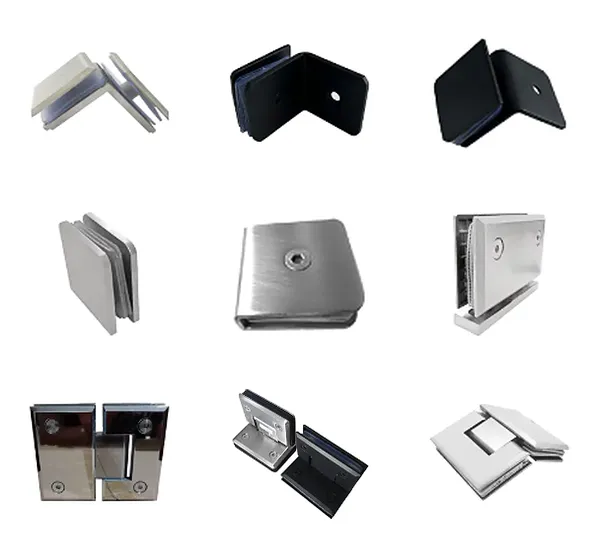
There are five interfaces that cover most residential and hospitality work:
Each of these has a different load path. The wall-mount hinge transfers the panel load into the building structure; the glass-to-glass hinge transfers it into the adjacent panel, which is why the fixed panel in that layout usually needs a support bar or a clamp set to stay rigid.
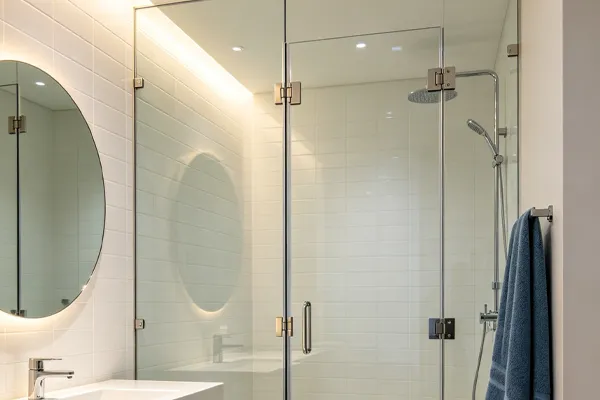
Shower hinge bodies are machined with a gasket pocket for a stated nominal thickness. HIPAD’s published shower system range works with tempered glass of roughly 8–12 mm, which covers the large majority of frameless enclosure production.
The misconception worth naming here: a hinge listed for 8–12 mm is not a hinge that accepts any thickness in that band interchangeably. The pocket is fixed and the gasket set is what changes. Fitting 12 mm glass into a 10 mm pocket by removing a gasket puts point load on the glass edge instead of distributing it across the rubber, and tempered glass fails from edge damage, not from surface pressure. When a supplier quotes a range, ask which gasket ships with which thickness, and order the gaskets with the hinges rather than as an afterthought.
Thin glass has the opposite problem. Below 8 mm, panels flex enough that a two-hinge door can bind against the seal at mid-height even when the hinge itself is correctly fitted.
The table below lists the reference values HIPAD publishes for its shower and bathroom hardware range. These are reference configurations; dimensions, materials and finishes are quoted against drawings for OEM and ODM orders.
| Parameter | Published Reference |
|---|---|
| Typical glass thickness, shower systems | 8–12 mm |
| Material options, shower systems | SUS201, SUS304, mixed zinc-alloy structures |
| Enclosure configurations supported | Swing, sliding, inline |
| Glass clamp angle configurations | 90° / 135° / 180° |
| Glass clamp materials | SS304 or zinc alloy |
| Glass clamp thickness range, selected models | Approx. 2–17 mm |
| Waterproof / magnetic strip length | Approx. 2 m standard |
| Strip glass compatibility | Approx. 6–10 mm, for approx. 90°–180° glass connections |
| Bathroom stainless handle diameters | 19 mm / 25 mm / 32 mm, SS304 on selected ranges |
| Finish options | Satin, mirror, matte black |
| Customization scope | Dimensions, materials, finishes, structure, logo engraving, packaging |
Two values in that table are worth reading together. The clamp range reaches 2–17 mm on selected models while the shower system range sits at 8–12 mm. That gap exists because a clamp is a static fixing and a hinge is a moving joint with a tighter tolerance envelope. A project that specifies 15 mm glass may find a clamp for it and no matching hinge, which forces a layout change late in the design.
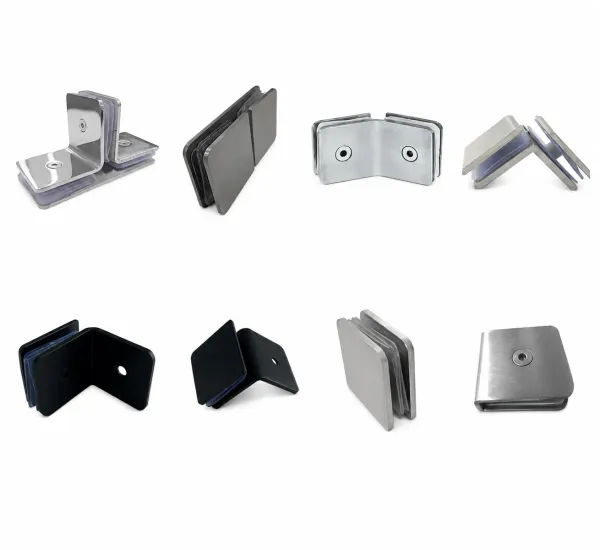
Three components get specified interchangeably in enquiries, and they do different work.
| Function | Shower Door Hinge | Glass Clamp | Support Bar |
|---|---|---|---|
| Function | Carries a moving panel and controls its swing | Fixes a static panel to a wall, floor or adjacent panel | Braces a fixed panel against deflection |
| Glass movement | Yes | None | None |
| Typical glass range | 8–12 mm | 2–17 mm on selected models | 8–12 mm |
| Angle options | Layout-specific (90° / 135° / 180° joints) | 90° / 135° / 180° | Wall-to-glass or glass-to-glass |
| Material options | SUS201 / SUS304 / zinc alloy | SS304 or zinc alloy | SS304 on selected ranges |
| Failure mode if undersized | Sag, drift out of alignment, seal contact | Panel movement, gasket compression loss | Visible panel flex, seal gap opening |
Run this before a purchase order, not after the glass is cut.
Out-of-plumb walls. A fixed-geometry wall-mount hinge assumes a plumb wall. On renovation work it usually isn’t. Either specify a hinge with lateral adjustment or budget for a packing solution at installation. Deciding this at the quotation stage costs nothing; deciding it on site costs a site visit.
Mixed-material finish matching. A satin SS304 hinge and a satin zinc-alloy clamp will not read as an identical finish under bathroom lighting, because the base metals reflect differently. Enclosure manufacturers supplying a single visible hardware set to a hotel specification should keep the material consistent within a sightline, or approve a physical finish sample of every component together rather than one at a time.
Self-closing expectations. Buyers frequently expect a shower hinge to hold the door at 90° and also return it to closed. Those are two different mechanisms with two different internal designs. Confirm the hold-open positions in writing.
Wide, short doors. A 900 mm wide door at 1,800 mm height concentrates torque on the hinge line differently than a narrow, tall panel of the same area. Panel weight alone doesn’t describe the load; give the supplier both dimensions.
A hinged frameless door offers a full-width opening, easy cleaning with no bottom track collecting residue, and hardware that can be replaced component by component without dismantling the enclosure.
Against that: a hinged door needs swing clearance inside the bathroom, so it rules out tight layouts that a sliding system handles without difficulty. Water containment depends entirely on the seal and gasket interface rather than on an overlapping panel, which makes seal specification a functional requirement rather than a finishing detail. And installation tolerance is unforgiving, since the frame that would normally absorb a few millimetres of error doesn’t exist. For high-turnover commercial bathrooms with irregular openings, a sliding configuration is often the lower-risk choice.
Compared with the catalog-stocked distributor programs common in this product category, a factory-direct route trades same-week availability for control over dimensions, material grade and mounting pattern. Distributors win on a broken hinge replaced tomorrow. Manufacturers win when the enclosure design needs a mounting pattern the catalog doesn’t carry.
ISO identifies ISO 9001 as the international standard that sets requirements for quality management systems (source: ISO, International Organization for Standardization). It describes how a manufacturer controls its process; it is not a product performance certificate for a hinge, and ISO itself does not certify individual suppliers. HIPAD states that it operates under an ISO 9001 quality management system and works with SGS and Bureau Veritas for third-party inspection, alongside incoming-material, in-process and finished-goods checks.
For a hinge programme, the useful requests are narrower than a certificate list:
That last point is where marketing language and compliance reality diverge most often. CE is a manufacturer’s declaration for products within scope, not a general quality approval, and applicability has to be confirmed product by product.
Pricing depends on the product specification, material, finish, order quantity and customization requirements. Contact HIPAD for a project-specific quotation. Published minimum order quantities of approximately 50–100 pieces per specification apply to selected customized stainless steel handle models and should not be assumed for hinges; confirm the MOQ for the specific model at quotation.
The variables that move a hinge price most are material grade, finish process, and whether the mounting pattern requires new tooling. HIPAD’s in-house tooling and mould resources, including more than 2,000 mould sets, affect the third of those directly, since an existing mould base removes development cost from a customized structure.
Q: What glass thickness do shower door hinges normally fit?
A: HIPAD’s published shower system range works with roughly 8–12 mm tempered glass. The hinge is machined for a nominal thickness within that band, and the gasket set is what matches it to the actual panel, so specify thickness and gasket together.
Q: Can I use a 90° glass clamp on a 135° corner?
A: No. The angle is built into the body geometry. HIPAD publishes 90°, 135° and 180° clamp configurations as separate items for that reason. Forcing the wrong angle preloads the glass edge.
Q: How many hinges does one shower door need?
A: It depends on panel weight and dimensions rather than on a fixed rule. Calculate the weight first (about 25 kg/m² at 10 mm), then give the supplier the weight together with the width and height, because a wide short door and a narrow tall door of equal weight load the hinge line differently.
Q: SUS304 or zinc alloy for a shower hinge?
A: SUS304 is the usual choice where corrosion exposure is continuous, and zinc alloy appears in mixed-structure systems where cost matters more than a long wet-service life. Match the decision to the service condition, and keep visible components in one material for finish consistency.
Q: Do hinges ship with the seals and gaskets?
A: Confirm it explicitly at quotation. Waterproof and magnetic strips are a separate range, published at approximately 2 m standard length for roughly 6–10 mm glass and 90°–180° connections, so a hinge order does not automatically cover the sealing interface.
Q: Can hinges be made to our own mounting pattern?
A: Yes. HIPAD develops customized hardware from drawings or samples, including structure, dimensions, material, finish, logo engraving and packaging, with engineering review and prototyping before mass production.
Q: What is the lead time impact of a custom hinge versus a standard one?
A: A custom structure adds engineering review, prototyping and, where no existing mould base fits, tooling development. Ask for the tooling status of the nearest standard model first, since matching an existing mould base is the shortest path to a customized part.
We will reply within 24 hours. For urgent requests, contact us on WhatsApp/WeChat at +86 137 9191 8989 or call the same number directly.
*We respect your confidentiality, and all information is protected.
We will only use your information to respond to your inquiry and will never send unsolicited emails or promotional messages.