













Company
16 October 2026
 11:37
11:37 A small door hinge can decide how well a door opens, closes, supports weight, and lasts over time. Choose the wrong hinge, and the door may sag, make noise, or fail early. Choose the right hinge, and the whole system works smoothly.
The four common types of hinges are butt hinge, concealed hinge, continuous hinge, and pivot hinge. A butt hinge is widely used for interior doors and standard doors. A concealed hinge is common for cabinet doors. A continuous hinge, also called a piano hinge, supports long panels. A pivot hinge allows doors to rotate from the top and bottom.
What Is a Hinge and Why Does It Matter?
What Are the 4 Main Types of Hinges?
What Is a Butt Hinge?
What Is a Concealed Hinge?
What Is a Continuous Hinge or Piano Hinge?
What Is a Pivot Hinge?
What Other Door Hinge Types Are Available?
How Do You Choose the Right Hinge Type?
What Materials and Finishes Should B2B Buyers Consider?
How Can Architectural Hardware Buyers Source Reliable Hinges?
A hinge is a hardware component that connects two parts and allows one part to rotate or swing. In buildings, hinges are mainly used on doors, cabinets, windows, gates, and access panels. A good hinge helps the door move smoothly, stay aligned, and remain safe during daily use.
A door hinge may look simple, but it carries real force. The hinge supports the door weight, controls movement, and affects the life of the full door system. If the hinge is too weak, the door can drop. If the screw holes are poor, the hinge may loosen. If the finish is not suitable, rust can appear.
For homeowners, hinges are a small repair item. For B2B buyers, they are a serious quality point. Hardware importers, distributors, building material suppliers, door manufacturers, cabinet makers, contractors, and architectural hardware brands need hinges that are stable, repeatable, and suitable for different project needs.
The four main types of door hinges commonly used in architectural and furniture hardware are:
| Hinge Type | Main Feature | Common Application |
|---|---|---|
| Butt hinge | Two leaves connected by a pin and knuckle | Interior doors, wooden doors, metal doors |
| Concealed hinge | Hidden when the door is closed | Cabinet doors, furniture, modern interiors |
| Continuous hinge / piano hinge | Runs along a long part of the door or panel | Long doors, panels, cabinets, toolboxes |
| Pivot hinge | Door rotates from top and bottom pivot points | Heavy doors, glass doors, modern entrances |
These four hinge types cover many common applications. A butt hinge is the most familiar. A concealed hinge gives a clean look. A continuous hinge spreads weight over a longer area. A pivot hinge creates smooth movement for special door designs.
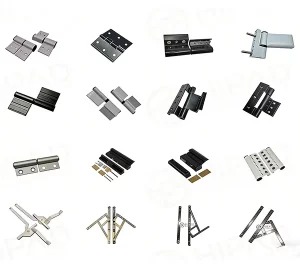
Of course, there are many other different types of hinges, including strap hinge, ball bearing hinge, spring hinges, barrel hinge, rising butt hinge, lift off hinges, parliament hinges, flush hinge, swing clear hinges, butterfly hinges, cranked hinges, overlay hinges, window hinges, gate hinge, fire door hinges, and other specialist hinges. But for most buyers, the four types above are the best starting point.
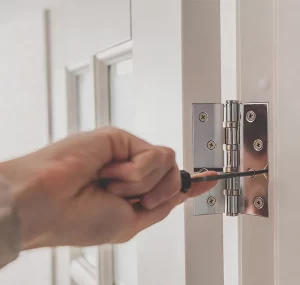
A butt hinge is one of the most common hinge designs. It has two rectangular leaves. One leaf is fixed to the door, and the other is fixed to the frame. The two leaves meet around a central pin and several rounded sections called the knuckle.
This type of hinge is widely used on interior doors, room doors, wooden doors, metal doors, and many standard building doors. In many projects, a butt hinge is the default choice because it is simple, strong, and easy to install.
A butt hinge can be mortised into the door and frame, which means the hinge sits flush with the surface. This gives a neat finish and helps the door close properly. For heavier doors, buyers may choose a thicker butt hinge, a stainless steel butt hinge, or a ball bearing version.
A type of butt hinge may also include a rising butt hinge or loose pin butt hinge. A rising butt hinge helps lift the door slightly when it opens, which can be useful when the floor is uneven or when clearance is needed.
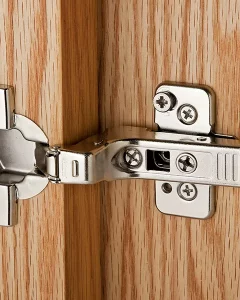
A concealed hinge is hidden when the door or cabinet is closed. This hinge type is often used in modern furniture, kitchen cabinets, wardrobes, bathroom cabinets, and high-end interior projects.
The most common concealed hinge is the cabinet hinge. It is usually fitted inside the cabinet door and frame, so users do not see the hinge from the outside. This gives the cabinet a clean and modern look.
For cabinet manufacturers and furniture brands, concealed hinges are very important because they affect both appearance and user experience. A poor cabinet hinge may loosen, squeak, or make the door uneven. A good cabinet hinge allows soft, smooth, and stable closing.
Some concealed hinges support soft-close function. Some are adjustable in multiple directions. Some are made for full overlay, half overlay, or inset cabinet doors. Overlay hinges are widely used when the cabinet door covers part or all of the cabinet frame.
A continuous hinge runs along the full length or a large part of the door or panel. It is also called a piano hinge because this hinge design was traditionally used on piano lids.
The main advantage of a continuous hinge is even weight distribution. Instead of placing the load on two or three separate hinge points, the hinge spreads the force along a long line. This helps reduce stress on the door, frame, and screw positions.
A piano hinge is useful for long panels, cabinets, machinery covers, storage boxes, electrical boxes, marine panels, and industrial access doors. In architectural hardware, it can also be used where strength and alignment are more important than decorative appearance.
For B2B buyers, continuous hinges can be customized by length, thickness, material, hole pattern, and surface finish. This makes them suitable for OEM/ODM hardware projects.
A pivot hinge allows a door to rotate from pivot points at the top and bottom, instead of swinging only from the side. This creates a different movement style from a normal butt hinge.
Pivot hinges are often used for heavy doors, glass doors, modern entrance doors, hidden doors, and large architectural doors. The weight of the door is transferred through the top and bottom pivot points, which can make the system more suitable for large or heavy door panels.
A pivot hinge can also help create a clean and modern design. Since the door turns around a pivot point, it can offer a special opening effect that works well in hotels, villas, office buildings, showrooms, and high-end commercial spaces.
When choosing a pivot hinge, buyers should check load capacity, installation method, floor condition, door thickness, and opening angle. A pivot system must match the actual door size and weight.
Besides the four main types, there are many types of hinges available for special applications. Each hinge design solves a different problem.
A ball bearing hinge includes small bearings between the knuckles. These bearings reduce friction and make the door move more smoothly. Ball bearing hinges are often used for heavier doors, high-frequency doors, and commercial buildings.
A strap hinge has long decorative leaves and is often used on gates, barn doors, garden doors, and rustic-style projects. A gate hinge may be stronger and larger, depending on the gate weight and outdoor exposure.
Other common options include:
These hinge types are not always interchangeable. A decorative hinge may look beautiful, but it may not support a heavy door. A strong bearing hinge may be excellent for commercial doors, but it may be unnecessary for a light cabinet.
To choose the right hinge, start with the door or panel itself. Ask: how heavy is it? How often will it open? Is it indoor or outdoor? Does it need to be hidden? Does it need automatic closing? Does the project require a decorative style?
The right hinge type depends on structure, function, and design. A cabinet needs a different hinge from an entrance door. A fire door needs a different hinge from a wardrobe. A gate needs a different hinge from a bathroom cabinet.
Practical Hinge Selection Table
| Application | Recommended Hinge Type | Why It Works |
|---|---|---|
| Standard interior doors | Butt hinge | Simple, strong, common |
| Heavy commercial doors | Ball bearing hinge | Smooth movement under load |
| Kitchen cabinets | Concealed hinge / cabinet hinge | Hidden, clean appearance |
| Long access panels | Continuous hinge / piano hinge | Even weight support |
| Glass or modern entrance doors | Pivot hinge | Smooth rotation and modern look |
| Gates and outdoor doors | Strap hinge / gate hinge | Strong and decorative |
| Self-closing doors | Spring hinges | Helps close automatically |
| Removable doors | Lift off hinges | Easy door removal |
| Wide-opening access | Parliament hinges or swing clear hinges | Better clearance |
A good rule is simple: choose a hinge based on load, movement, environment, and appearance. Not just price.
Hinges are made from different materials, including stainless steel, carbon steel, zinc alloy, brass, aluminum, and other metals. For architectural hardware, stainless steel is popular because it offers good corrosion resistance, strength, and a clean appearance.
For outdoor doors, coastal projects, bathrooms, hotels, and humid environments, stainless steel hinges are often a better choice. For indoor furniture and light-duty cabinet use, zinc alloy or steel cabinet hinge products may be more cost-effective.
Surface finish also matters. A hinge can be polished, brushed, satin, chrome-plated, black-coated, bronze-colored, or customized to match the project style. For architectural hardware brands, finish consistency is important because buyers want matching handles, locks, hinges, bathroom hardware, and railing parts.
Common Hinge Material Options
| Material | Main Advantage | Common Use |
|---|---|---|
| Stainless steel | Corrosion resistance, strong appearance | Doors, bathrooms, outdoor projects |
| Carbon steel | Strong and cost-effective | Interior doors, industrial use |
| Brass | Decorative and corrosion-resistant | Premium doors, classic interiors |
| Zinc alloy | Flexible and economical | Cabinet and furniture hardware |
| Aluminum | Lightweight and rust-resistant | Light doors, special systems |
For OEM/ODM buyers, material, thickness, screw hole design, knuckle structure, pin quality, and surface finish should all be confirmed before mass production.
For global hardware importers, distributors, building material suppliers, door and window manufacturers, system fabricators, project contractors, architectural hardware brands, and bathroom hardware buyers, reliable supply is essential.
As a China-based architectural hardware manufacturer, we provide door hardware, window hardware, bathroom hardware, stainless steel hardware, and stainless steel railing systems. We support factory-direct production and OEM/ODM customization for global B2B customers.
When sourcing hinges, buyers should check:
A low-quality hinge may create after-sales problems. A reliable hinge can improve the full door system and reduce project risk. This is especially important for commercial projects, hotel projects, apartment buildings, bathroom hardware programs, and architectural hardware brands.
Imagine a hotel project with 300 guest rooms. Each room needs an entrance door, bathroom door, wardrobe cabinet, and several access panels. The buyer needs smooth operation, good finish consistency, and stable supply.
For guest room entrance doors, the project may use ball bearing hinges or strong butt hinges. For bathroom doors, stainless steel hinges may be better because of moisture. For wardrobes, concealed cabinet hinges may be the best choice. For service panels, a continuous hinge may reduce alignment problems.
If the buyer chooses only by price, some hinges may fail early. Doors may sag. Screws may loosen. Guests may complain. Maintenance costs rise.
If the buyer chooses by application, load, material, and finish, the result is much better. Doors move smoothly. The appearance stays consistent. The project owner gets fewer complaints. The supplier builds trust.
That is the real value of choosing the right hinge.
What are the 4 most common types of hinges?
The four most common types are butt hinge, concealed hinge, continuous hinge, and pivot hinge. These cover many door, cabinet, panel, and architectural hardware applications.
Which hinge is best for interior doors?
A butt hinge is usually the best common hinge for interior doors. For heavier or high-use interior doors, a ball bearing hinge may provide smoother movement and longer service life.
What is the best cabinet hinge?
A concealed cabinet hinge is usually the best choice for modern cabinets. It stays hidden when the cabinet is closed and can often be adjusted for better alignment.
What is a piano hinge used for?
A piano hinge, also called a continuous hinge, is used for long panels, cabinet doors, access covers, toolboxes, and applications where force should be spread across a longer area.
Are ball bearing hinges better than standard butt hinges?
Ball bearing hinges are better for heavy or high-use doors because the ball bearing reduces friction. For light interior doors, standard butt hinges may be enough.
Which hinge should I use for heavy doors?
For heavy doors, choose a strong butt hinge, ball bearing hinge, or pivot hinge, depending on the door design. Always check load capacity, material thickness, and screw fixing strength.
Can hinges be customized for OEM projects?
Yes. Hinges can be customized by size, material, finish, screw hole position, packaging, logo, and application. OEM/ODM customization is useful for hardware brands, distributors, and project suppliers.
The four main types of hinges are butt hinge, concealed hinge, continuous hinge, and pivot hinge.
A butt hinge is widely used for standard doors and interior doors.
A concealed hinge is common for cabinet doors and modern furniture.
A continuous hinge or piano hinge supports long panels and spreads force evenly.
A pivot hinge is suitable for heavy doors, glass doors, and modern entrance designs.
Other hinge options include strap hinge, ball bearing hinge, spring hinges, barrel hinge, lift off hinges, parliament hinges, and decorative hinges.
The right hinge depends on door weight, use frequency, material, environment, and design style.
B2B buyers should check material, finish, load capacity, screw structure, corrosion resistance, and supplier stability.
A reliable architectural hardware manufacturer can provide standard hinges, customized solutions, OEM/ODM support, and factory-direct supply.
We will reply within 24 hours. For urgent requests, contact us on WhatsApp/WeChat at +86 137 9191 8989 or call the same number directly.
*We respect your confidentiality, and all information is protected.
We will only use your information to respond to your inquiry and will never send unsolicited emails or promotional messages.