













Bedrijf
27 September 2026
 10:07
10:07 Allen Wang | CEO and Founder, HIPAD
Updated: September 27, 2026
Back to back door handles use paired grips connected through the door leaf, but the mounting stack changes with glass, framed doors and solid panels. B2B buyers should define the finished leaf thickness, overall length, fixing centers, projection, material, finish, gaskets and fasteners before approving a sample.
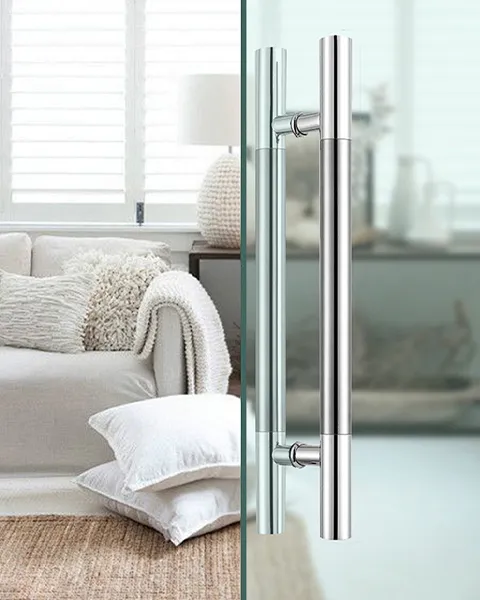
HIPAD’s supplied product reference separates two useful ranges. Stainless-steel glass pull handles are listed in SUS304 or SUS201 for 8-12 mm glass and 300-1200 mm lengths. Sliding back-to-back handles are listed for 10-40 mm doors and 200-800 mm lengths. These are family ranges, not a promise that every material, length and thickness combination is available in one model.
| Specification point | Glass pull-handle family | Sliding back-to-back family | Buyer approval evidence |
|---|---|---|---|
| Leaf thickness | 8-12 mm glass | 10-40 mm doors | Finished leaf section and tolerance |
| Published length range | 300-1200 mm | 200-800 mm | Model drawing with overall length |
| Published material | SUS304 or SUS201 | Confirm by selected model | Material declaration or agreed evidence |
| Mounting interface | Glass holes, gaskets and through-fastening | Door construction and through-fastening | Section drawing and installed sample |
| Price | Requires quotation | Submit model, quantity, finish and packaging | |
Compared with single-sided pulls fixed to a prepared substrate, a paired assembly must control both handle alignment and the complete fastener stack through the leaf. A finish sample alone cannot validate that interface.
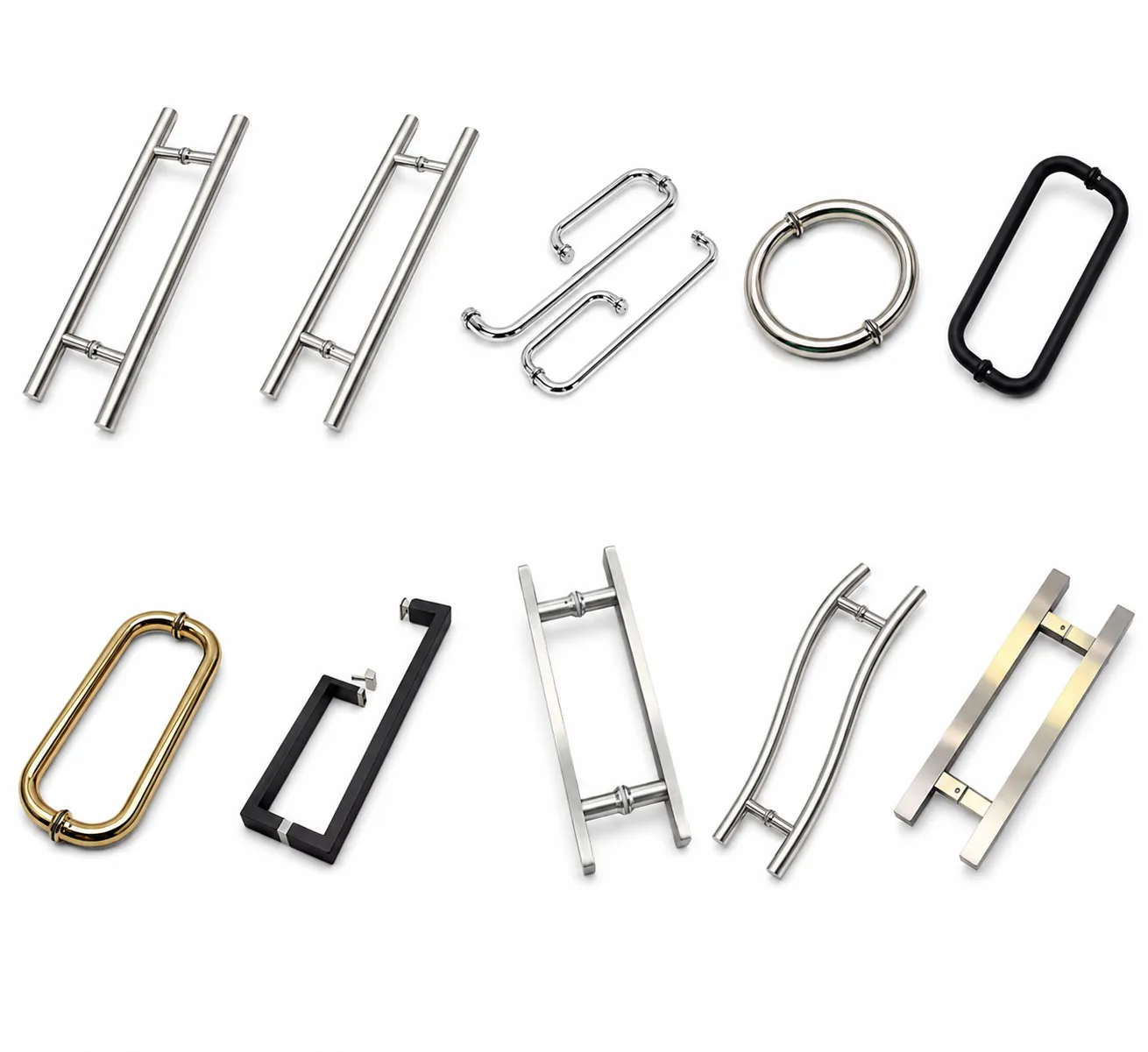
Overall length describes the visible end-to-end size. Fixing centers locate the drilled or machined holes. Projection is the distance from the door face to the gripping surface. A purchase order that lists only one 鈥渉andle length鈥?leaves the hole pattern and hand clearance undefined.
Put all three dimensions on the same drawing. Show the tube or grip section as well, because a change in section can affect the visual scale, grip and compatibility with end fittings even when the fixing centers stay unchanged.
For glass, record the actual glass thickness, hole diameter and position, edge distance, gasket material, spacer arrangement and tightening method. Those values are model-specific and are not disclosed as universal numbers in the supplied catalog. They must come from the selected drawing.
For framed, clad or solid doors, identify every layer in the fixing stack. Face material alone is not enough; the installer needs to know whether reinforcement or a prepared fixing point is present behind it. Cladding added after sampling is a common edge case because it changes the required fastener engagement and can shift handle alignment.
The published glass-pull family lists SUS304 and SUS201. SUS304 is often requested where corrosion exposure is a stronger concern, while SUS201 can suit cost-controlled indoor configurations when the selected finish and environment are appropriate. The correct decision still depends on the model, exposure and project specification.
Ask the supplier to identify the grade for the quoted configuration. Do not treat a stainless appearance as grade evidence, and do not extend one model’s material statement to the full family. The public source does not disclose a universal certificate number for these handles.
A back-to-back pair places two visible handles on opposite faces, so color, texture, gloss and end-detail alignment should be approved together. Define the viewing standard for the finish sample and state whether exposed fasteners, covers or logos must face a particular direction.
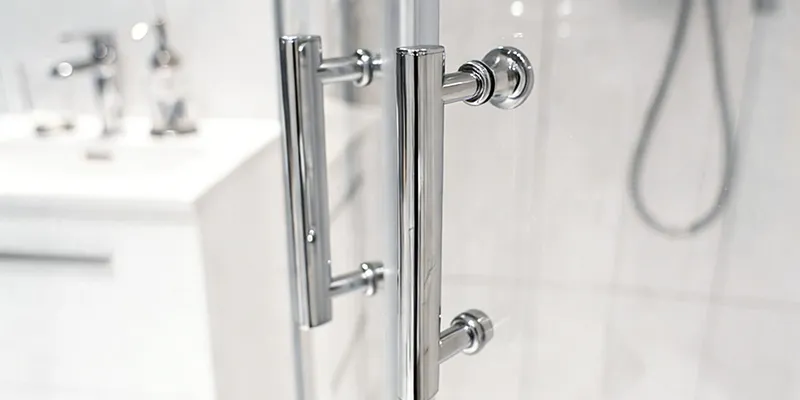
Advantages: a paired pull provides a matching grip on both faces, shares one coordinated hole pattern and can simplify visual consistency across a glass or sliding-door program. The format also allows the buyer to approve both exterior-facing surfaces in one sample.
Limits: through-fastening makes the assembly sensitive to leaf thickness, hole position and the full gasket or cladding stack. It is not automatically interchangeable with a single-sided handle, and a longer handle does not by itself establish load suitability. Load, fastener and substrate validation remain configuration-specific.
Include door type, finished thickness, overall handle length, fixing centers, projection, grip section, material, finish, quantity and destination packaging requirements. Attach a door section or drilling drawing rather than relying on a product photo. Price requires a quotation because the source does not publish a universal price range.
Review HIPAD’s stainless steel handle range en bathroom glass door handles. For adjacent procurement checks, use the commercial pull-handle dimensions guide and the glass door handle supplier guide. Send the completed specification through the HIPAD contact page.
The supplied HIPAD reference lists 10-40 mm doors for the sliding back-to-back handle family.
The sliding back-to-back family is listed at 200-800 mm. The related glass pull-handle family is listed at 300-1200 mm, so buyers should confirm which family and model their project uses.
Do not assume interchangeability. Confirm the selected model’s fixing method, leaf thickness range, hole pattern, fasteners and backing requirements.
Both grades are listed for the related stainless-steel glass pull family. The grade for a specific back-to-back model must be confirmed in the quotation and approval documents.
Show overall length, fixing centers, projection, grip section, hole details and the complete door or glass section.
Allen Wang is CEO and Founder of HIPAD. He began as a technical engineer in 1998 and focuses on manufacturing, tooling, quality, OEM/ODM development and architectural hardware supply.
Wij antwoorden binnen 24 uur. Neem voor dringende aanvragen contact met ons op via WhatsApp/WeChat op +86 137 9191 8989 of bel rechtstreeks naar hetzelfde nummer.
*Wij behandelen uw gegevens vertrouwelijk en beschermen alle informatie.
Wij gebruiken uw gegevens uitsluitend om op uw aanvraag te reageren en sturen nooit ongevraagde e-mails of promotionele berichten.