


Move
Roulettes pour portes coulissantes
Single, tandem, embedded and strip rollers with nylon, POM, PU or steel wheels and ZZ / RS bearings.
Sliding door hardware is every part that makes a sliding door carry its weight, move, close and lock: rollers and tracks, guides and stoppers, locks and keepers, handles, frame corner joints and seals. HIPAD has made rollers since 2000 and now supplies the full hardware set for aluminum patio doors, interior sliding doors, wardrobes and glass sliding systems, including a 2+1 synchronized sliding system. Profile system companies, door and window factories and distributors in 60+ countries buy complete sets or single parts from our factory.
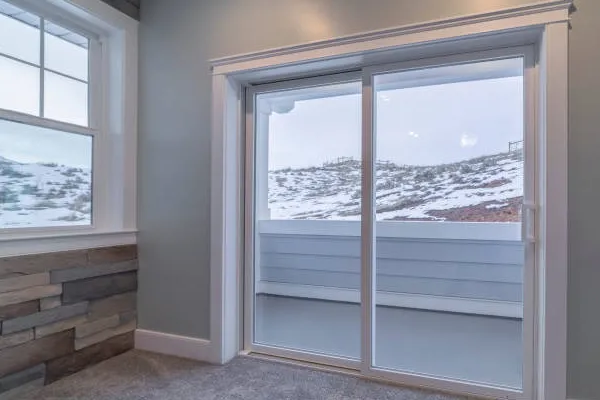
A sliding door moves along a track instead of swinging on hinges. Its hardware splits into four jobs. Carry and move: rollers, tracks, top guides and stoppers. Close and seal: interlock profiles, brush seals and weatherstrips. Lock and operate: sliding door locks, keepers and handles. Hold the frame together: corner joints and connectors in the aluminum profile.
The same names cover very different doors: a heavy aluminum patio door rolling on a sill track, a wooden or glass door hanging from an overhead rail, a wardrobe door, or a synchronized interior door where two panels open together. The right hardware depends on the door system, panel weight and frequency of use. In Spanish the parts are often called herrajes para puertas corredizas ou accesorios para puertas corredizas, and rollers roldanas.
The drawing shows a two-panel aluminum sliding door. Each numbered part links to the HIPAD range that supplies it.
| # | Part | Job | HIPAD range |
|---|---|---|---|
| 1 | Top track and guide | Keeps the panel upright and in line | Track systems |
| 2 | Rouleaux | Carry the panel weight and let it slide | Roulettes pour portes coulissantes |
| 3 | Bottom track | Running surface for the rollers | Track systems |
| 4 | Lock and keeper | Hook or latch that locks the panel to the frame | Sliding door locks |
| 5 | Poignée | Flush pull or lever handle that operates the lock | Poignées de portes et fenêtres |
| 6 | Équerres d’angle | Join the aluminum profiles at the sash corners | Équerres d’angle |
| 7 | Interlock seal | Brush or rubber seal where the panels meet | Joints d’étanchéité et accessoires |
| 8 | Stoppers and guides | Stop the panel at the end of travel and guide it | Joints d’étanchéité et accessoires |
Each range has its own page with models and specifications. Order single parts or a complete set matched to your profile system.
Single, tandem, embedded and strip rollers with nylon, POM, PU or steel wheels and ZZ / RS bearings.

Matched tracks and strip rollers for doors, cabinets and linear sliding applications.
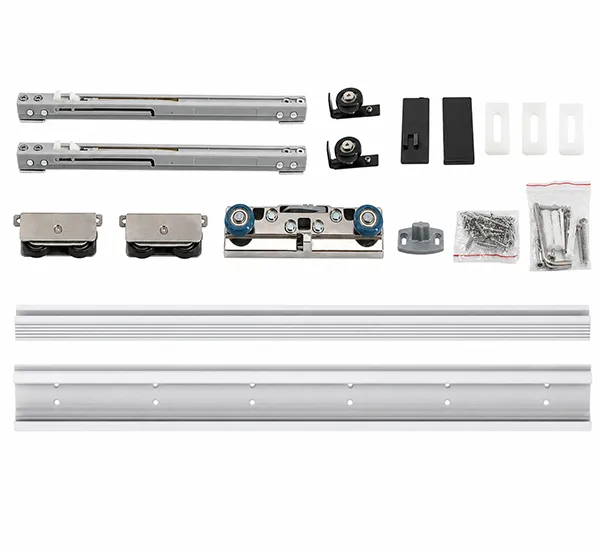
Belt-driven short-track system for interior doors and wardrobes, 35–100 kg, 70 mm soft-stop buffer.

Hook and flush locks for aluminum sliding doors 30–60 mm thick, with or without key.
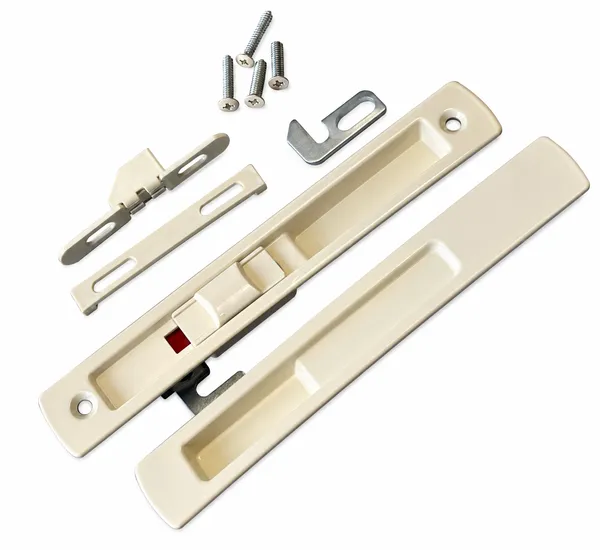
Compact lock handles for aluminum sliding windows and light sliding doors.

Flush handles, lever handles and handle sets in aluminum and zinc alloy for door and window systems.

Corner joints and angle brackets that hold aluminum door and window sashes square.

Réponse rapide : bottom-rolling aluminum patio doors need rollers, a sill track, a hook lock and a flush handle; top-hung interior, barn-style and glass doors need hanging rollers on an overhead rail with a floor guide; wardrobes use light bypass rollers; and synchronized doors add a belt or cable that moves two panels together.
| Système | Comment ça marche | Key hardware | Utilisation courante | HIPAD supply |
|---|---|---|---|---|
| Bottom-rolling aluminum door | Panel rolls on rollers in the bottom rail along a sill track | Tandem or embedded rollers, top guide, hook lock, flush handle, corner joints, brush seals | Patio and balcony doors, shop fronts | Complete hardware set |
| Sliding window | Same as above at a smaller scale | Window rollers, crescent or hook lock, lock handle, corner joints | Aluminum and uPVC windows | Complete hardware set; see Quincaillerie de fenêtre |
| Top-hung interior door | Door hangs from rollers on an overhead track | Hanging rollers, top track, floor guide, stoppers, soft-close | Interior rooms, pocket doors | Hanging rollers and roller systems |
| Synchronized (2+1) | A belt links the panels so they open together | Short track, carriages, belt, buffers | Interior doors, wardrobes, partitions | Complete 2+1 system |
| Wardrobe bypass door | Two or more doors pass each other on parallel tracks | Light top or bottom rollers, guides | Closets and cabinets | Wardrobe rollers |
| Frameless glass sliding door | Glass hangs from rollers on a rail or tube | Glass clamp rollers, rail, stoppers, floor guide, pull handle | Showers, glass partitions, barn-style glass doors | Sliding glass systems |
In a synchronized sliding system, pulling one door panel moves the linked panel at the same time, so a wide opening clears in one movement. The HIPAD Short Track 2+1 system uses a belt drive on a short, low track, which keeps the visible hardware small. A buffer at each end slows the doors over the last 70 mm so they close softly.
| Sliding structure | Belt-driven synchronized sliding |
|---|---|
| Door weight | 35–100 kg |
| Buffer stroke | 70 mm |
| Minimum door leaf | ≥ 520 mm wide |
| Service life (stated) | 80,000 cycles |
| Materials | Metal and engineering plastic |
| Uses | Interior doors, wardrobes, commercial partitions |
See the 2+1 specification guide for what to confirm before ordering.

A sliding door lock usually uses a hook that swings into a keeper on the frame, because a sliding panel cannot use a normal latch bolt. Choose the lock by door thickness and profile, then choose a handle that fits the lock spindle and the profile face.
| Lock type | Use | Door / frame | Matériel |
|---|---|---|---|
| Sliding door hook lock | Portes coulissantes en aluminium | 30–60 mm doors | Alliage de zinc |
| Mortise lock | Aluminum doors with lever handles | 35–70 mm doors | Steel and zinc alloy |
| Crescent lock | Fenêtres coulissantes | Window frame systems | Aluminium |
| Multi-point lock | Entrance and large doors | 40–80 mm doors | Steel core |
| Handle type | Use | Cadre |
|---|---|---|
| Flush (recessed) handle | Sliding windows and doors, panels that pass each other | 30-60 mm |
| Lock handle | Sliding windows and light doors | Profile-specific |
| Lever handle with lock | Aluminum doors with mortise lock | 35 à 60 mm |
| Pull handle | Glass and timber sliding doors | Through-fixed or face-fixed |
Door weight drives the roller choice and affects the track, lock and handle. Estimate it first: glass weighs about 2,5 kg par m² par millimètre, and an aluminum frame adds roughly 20–30%. A 1000 × 2200 mm sash with 5 + 5 mm double glazing weighs about 69 kg.
Choose rollers rated for at least 1.5 times the weight each roller carries. Our roller load guide explains the calculation step by step.
| Panel weight | Typical hardware |
|---|---|
| Up to 40 kg | Window rollers, wardrobe rollers, light top-hung rollers |
| 35–100 kg | 2+1 synchronized system for interior doors |
| 40–80 kg | Single-wheel door rollers with bearings |
| 80–150 kg | Tandem or embedded rollers, heavier track |
| Above 120 kg | Roller strips with 4–8 wheels or steel-wheel heavy-duty rollers |
A typical parts list per sliding sash. Your profile system decides the exact models; send the profile drawing and we return a matched list.
| Part | Qty per sash |
|---|---|
| Rollers (single, tandem or embedded) | 2 |
| Top guides or guide blocks | 2 |
| Sliding door lock with keeper | 1 set |
| Handle (flush or lever) | 1 set |
| Équerres d’angle | 4 |
| Stoppers / bumpers | 1–2 |
| Interlock brush or rubber seal | By sash height |
| Weatherstrip | By sash perimeter |
| Part | Common materials | Finitions |
|---|---|---|
| Roller housings | Galvanized steel, stainless steel 304 / 316, aluminum, nylon | Zinc plated, stainless |
| Roller wheels | Nylon, POM, PU, steel | Wheel color by choice |
| Serrures | Zinc alloy, steel | Plated, black, powder coated |
| Handles | Aluminum, zinc alloy | Anodized, powder coated, plated |
| Équerres d’angle | Aluminum, zinc alloy | Mill or coated |
For bathrooms, pools and coastal buildings, specify stainless steel roller housings and sealed (RS) bearings.

Quiet rollers, soft-close options and slim handles for patio, balcony and interior doors.

Light rollers and slim handles for space-saving glass and aluminum partitions.

Heavy-duty rollers, locks and pull handles for high-traffic shop and office doors.

Stainless steel rollers, rails and stoppers for 8–12 mm frameless glass.
Project references: residential sliding doors, California, USA et apartment glass doors with sliding rollers, Vancouver, Canada.
| Problème | Cause probable | Corriger |
|---|---|---|
| Door hard to slide | Worn rollers or dirty track | Clean the track; adjust or replace rollers |
| Lock does not catch | Keeper and hook out of line | Re-level the rollers, then reset the keeper |
| Draughts or rattling | Worn interlock or brush seals | Replace seals and weatherstrips |
| Door jumps the track | Wrong roller groove or worn top guide | Match the roller to the track; replace guides |
| Synchronized doors out of step | Belt tension or carriage position | Re-tension the belt and reset the carriages |
HIPAD began in 2000 with bearings and rollers, the core of every sliding door. From 2016 we used that experience to build complete sliding systems, and today we supply rollers, locks, handles, corner joints and accessories as one matched set. Wheels are molded on our own injection machines, and every set is checked for fit against the customer's profile before mass production.
HIPAD est ISO 9001 certifiés, et les produits concernés portent CE, GS et CSA C-UL certification. SGS or BV third-party inspection is available.
| 1. Profile or sample | Send a profile drawing, sample or parts list |
|---|---|
| 2. Échantillons | 5–7 days for existing models |
| 3. Production | 20–25 working days · MOQ from 1000 pcs by model |
| 4. Expédition | FOB Qingdao ou tout port chinois · acompte de 30 %, 70 % avant expédition |
| Terme | Signification | Également appelé |
|---|---|---|
| Sash | The moving panel of a sliding door or window | Leaf, panel |
| Interlock | Profile where two panels overlap when closed | Meeting stile |
| Hook lock | Lock whose hook swings into a keeper | Sliding door latch, cerradura de gancho |
| Keeper | Plate on the frame that receives the hook | Strike, catch |
| Flush handle | Recessed handle that lets panels pass each other | Flush pull, recessed pull |
| Synchronized door | Panels linked so they open together | Telescopic door, 2+1 system |
| Soft-close | Damper that slows the door at the end of travel | Buffer, soft stop |
| Corner joint | Insert that joins two profiles at a corner | Corner cleat, corner connector |
Une porte coulissante nécessite des roulettes et un rail pour supporter et déplacer le panneau, des guides supérieurs et des butées, une serrure avec gâche, une poignée, ainsi que des joints au niveau du montant de recouvrement et autour du cadre. Les portes coulissantes en aluminium nécessitent également des équerres d’assemblage pour monter l’ouvrant.
Dans une porte à roulement inférieur, le poids repose sur des galets situés dans le rail inférieur, qui roulent sur un rail de sol ou de seuil ; cette solution convient aux lourdes portes-fenêtres en aluminium. Dans une porte suspendue, le poids est supporté par des galets sur un rail supérieur et un guide au sol maintient uniquement la porte alignée ; cette solution convient aux portes intérieures, de style grange et en verre.
Une courroie ou un câble relie les panneaux ; ainsi, tirer un panneau déplace l’autre en même temps et l’ouverture se dégage en un seul mouvement. Le système HIPAD Short Track 2+1 est entraîné par courroie, supporte des portes de 35 à 100 kg et dispose d’un amortisseur à fermeture douce de 70 mm.
La plupart des portes coulissantes en aluminium utilisent une serrure à crochet qui s'engage dans une gâche sur le cadre. Les serrures pour portes coulissantes HIPAD conviennent aux portes de 30 à 60 mm d'épaisseur et sont disponibles avec ou sans cylindre à clé.
Estimez le poids du panneau, répartissez-le entre les roulettes et choisissez des roulettes prévues pour au moins 1,5 fois cette charge. Faites ensuite correspondre la gorge de la roue au rail et le boîtier à la cavité du profilé. Notre guide des roulettes pour portes coulissantes explique chaque étape.
Oui. Envoyez le dessin du profilé ou un échantillon de porte. Nous y adaptons les roulettes, guides, serrures, poignées, équerres d’assemblage et joints, et pouvons les emballer en un kit par porte ou en vrac.
Utilisez des boîtiers de roulettes en acier inoxydable, des roulements étanches (RS) et des serrures et poignées plaquées ou thermolaquées. L’acier simplement zingué se corrode plus rapidement dans les zones côtières et autour des piscines.
La MOQ commence à 1 000 pièces et dépend du modèle. Les échantillons de modèles existants nécessitent 5 à 7 jours et la production de masse 20 à 25 jours ouvrables. La personnalisation du logo et de l’emballage est possible même pour de petites quantités.
HIPAD est un fabricant fondé en 2000 à Qingdao, en Chine. L’entreprise a débuté avec les roulements et les roulettes et produit désormais une quincaillerie coulissante complète grâce à ses propres moules et machines d’injection. HIPAD est certifiée ISO 9001. Qingdao Hipad International Trade Co., Ltd. gère l’exportation.
A roller and sliding hardware factory since 2000, supplying profile system companies, door and window factories, distributors and importers in 60+ countries. Our commitment includes:
Send your profile drawing, door size and weight. We reply within 24 hours with a matched hardware list and a factory price.
Nous répondons sous 24 heures. Pour toute demande urgente, contactez-nous sur WhatsApp/WeChat au +86 137 9191 8989 ou appelez directement ce même numéro.
*Nous respectons la confidentialité de vos données et protégeons toutes les informations transmises.
Nous utiliserons vos informations uniquement pour répondre à votre demande et n'enverrons jamais d'e-mails non sollicités ni de messages promotionnels.
 Roulettes pour portes coulissantes
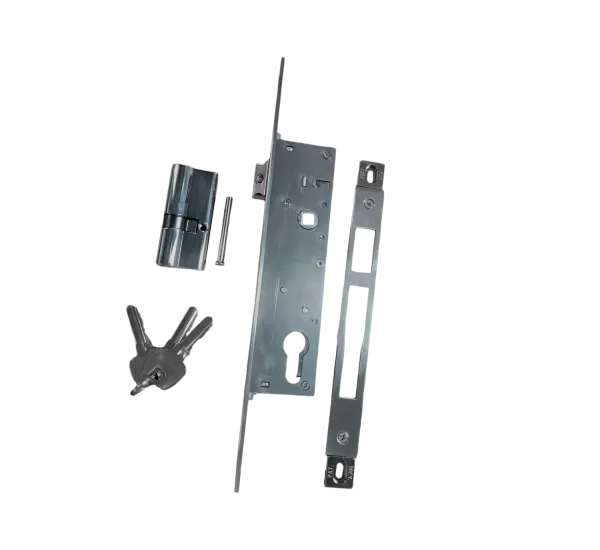 Serrures pour portes et fenêtres
 Quincaillerie de fenêtre
 Sliding Shower Hardware