


Bedrijf
19 oktober 2026
 10:02
Allen Wang | CEO en oprichter, HIPAD
Updated: October 18, 2026
A window hinge manufacturer should give you more than a thickness range. HIPAD’s supplied Window Hinges reference separates standard, industrial, furniture and heavy-duty hinge families, but does not assign a universal numeric sash-load rating. Use those ranges to shortlist a family, then approve a specific hinge against the window profile, fixing pattern and actual opening geometry.
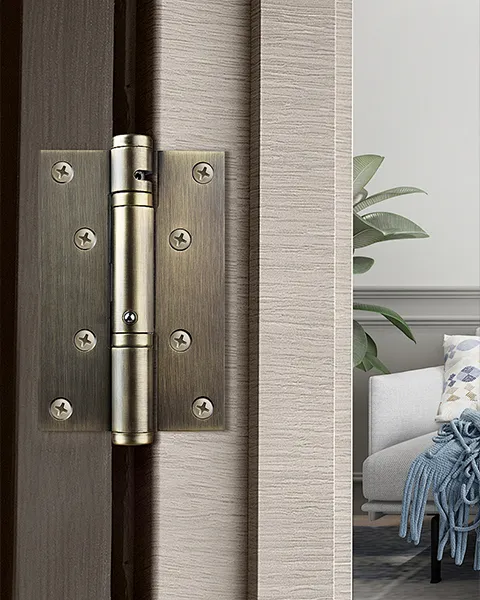
The following is the HIPAD Window Hinges family reference, not a model-level performance certificate. Leaf thickness helps compare the options; it does not specify pin diameter, fastener strength, sash mass, corrosion resistance or service life.
| Hinge family | Published thickness | Published load description | Opening reference | What to confirm on the quoted model |
|---|---|---|---|---|
| Standard stainless-steel | 2-3 mm | Medium load | 180 degrees | Leaf size, pin, fixing centers and profile clearance |
| Industrieel | 3-5 mm | High load | Not stated for this family | Declared angle and model-specific duty evidence |
| Furniture | 1.5-2 mm | Light load | 120-180 degrees | Whether this family is appropriate for the actual application |
| Zwaar uitgevoerd | 4-6 mm | Heavy load | 180 degrees | Complete sash-and-frame test arrangement |
For window production, start with the Window Hinges range and request a drawing of the exact offered part. The wider hinge range can help compare family forms, but a door-hinge specification cannot simply be transferred to a window sash. HIPAD does not publish a product certificate number or a numerical load for every hinge in the supplied reference.
A 4 mm leaf is not automatically a better fit than a 3 mm leaf. The sash mass, width, center of gravity, number of hinges, fixing substrate and opening direction all affect the assembly. A thicker leaf may also move the sash relative to the seal or leave insufficient clearance in a shallow profile. Compared with buying from a generic thickness table, a drawing-based OEM review tests both the hinge and the window system.
Send the manufacturer a sash-and-frame section, handing, target opening, glazing weight, fixing material and expected environment. Ask for the leaf dimensions, pin and knuckle geometry, hole centers, screw specification and finish for the quoted model. The family descriptions “medium”, “high” and “heavy” should not be converted into a kilogram claim without model-specific evidence.

The published 180-degree reference for standard and heavy-duty families describes a hinge-family capability, not a guarantee that the installed window can open that far. A reveal, adjacent wall, trim, handle, restrictor or weather seal may stop travel sooner. The furniture family has a broader 120-180-degree reference, while the industrial family needs an exact model angle confirmed.
Build a sample into the intended profile, then measure clearance at closed, partly open and fully open positions. Check that the sash does not bind, strike adjacent construction or pull the fixings. For projects using other hardware, coordinate the hinge with hinge selection fundamentals and the complete hardware schedule.
The supplied standard family is described as stainless steel. Do not assume the same grade, pin material or finish for every industrial or heavy-duty option. For coastal or frequently washed installations, define the exposure and ask for the exact material, finish and test basis. The selection can be revised if the available model evidence does not cover the application.
EN 1935 specifies requirements and test methods for single-axis hinges; it is useful language for discussing testing. It is not proof that a HIPAD model is certified. If a project requires conformity, request a model-specific report and check its scope, issuing body and current validity. HIPAD’s supplied product reference does not disclose such report numbers.

HIPAD describes OEM/ODM support for custom drawings, structure, finishes and packaging. Ask the team to identify which changes require a new sample or tooling. The manufacturer evaluation guide covers wider supplier-control questions. Product-level pricing is not disclosed in the source material; request a quotation for the defined model and quantity.
No. Frame geometry, nearby surfaces, seals and other hardware can limit the installed angle. Measure it on the assembled window.
Nee. Dikte is slechts één dimensie. Het geoffreerde scharnier moet in het profiel passen en vergezeld gaan van bewijsstukken die aansluiten bij de vleugel, de bevestiging en de gebruiksomstandigheden.
Ga er niet van uit dat scharnieren uitwisselbaar zijn op basis van een gedeelde serienaam of vergelijkbare dikte. Vergelijk de exacte tekeningen, de bevestigingswijze, de opening en de toepassingsbewijzen.
Send sash and frame drawings, mass, opening direction, material and finish requirements, target quantity and any project test requirement. Include an existing sample for replacement-fit work.
For a model drawing, sample plan or quotation, contact HIPAD met het raamprofiel en de beoogde montagedetails. De volgende beslissing is of het aangeboden model past op de gemonteerde vleugel, en niet welke serienaam het krachtigst klinkt.
About the author: Allen Wang is CEO and Founder of HIPAD. His supplied background describes manufacturing experience beginning in Qingdao bearing production in 1998 and work with international door and window hardware buyers. This guide uses HIPAD’s Window Hinges product reference; model-level performance claims require separate evidence.
Wij antwoorden binnen 24 uur. Neem voor dringende aanvragen contact met ons op via WhatsApp/WeChat op +86 137 9191 8989 of bel rechtstreeks naar hetzelfde nummer.
*Wij behandelen uw gegevens vertrouwelijk en beschermen alle informatie.
Wij gebruiken uw gegevens uitsluitend om op uw aanvraag te reageren en sturen nooit ongevraagde e-mails of promotionele berichten.